 Kyle Alexandre Struan
The Conquest of Mexico Was More Astonishing Than You Think
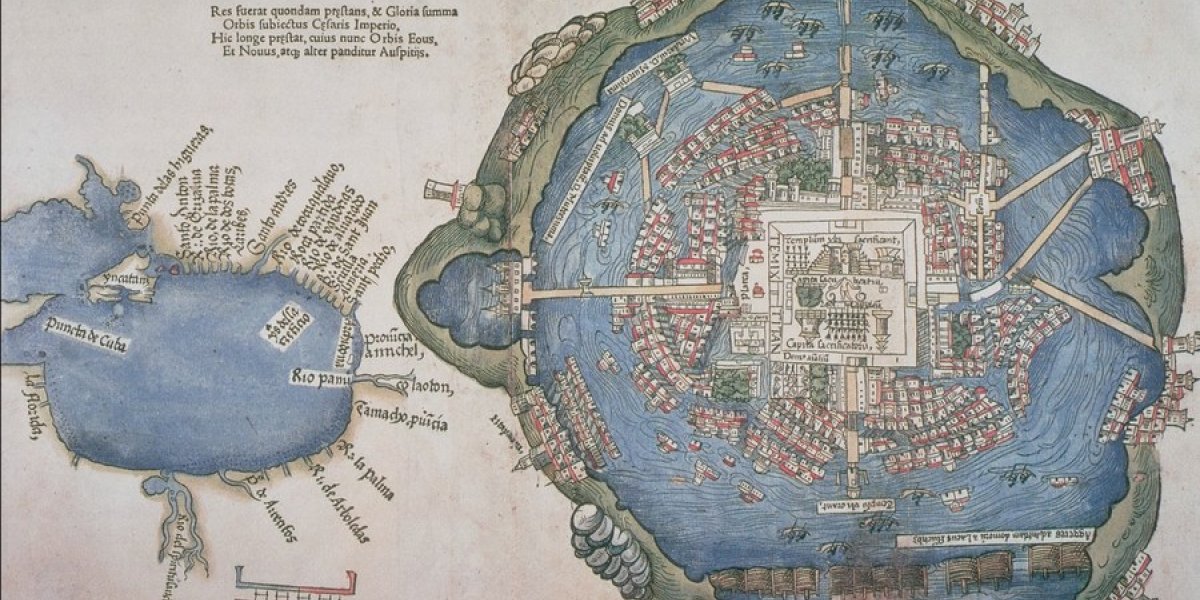
The Nuremberg Map (1524), published alongside Hernán Cortés's Second Letter to Charles V, as preserved at the Newberry Library in Chicago.
And it's the setting of my historical fiction trilogy, The Feathered Serpent. Let's clear up the myths together.
Every few years, someone with an important title demands that Spain apologise for the Conquest of Mexico. And every few years, the same question goes unanswered: apologise for what, exactly, and to whom?
That's not a rhetorical question. It's the question this post is going to try to answer — without the manufactured guilt some people have spent five centuries trying to sell us.
What almost nobody tells you
Before 1519, there was no "Mexico." There was a mosaic of peoples — Tlaxcalans, Totonacs, Texcocans, and dozens more — subjugated by force under the Mexica empire, which demanded tribute, forced labour, and, with some regularity, their children for sacrifice. That's not a Spanish accusation. It's what the codices themselves, and the Nahua chronicles later recorded by friars like Sahagún, say.
When Hernán Cortés landed at Veracruz with barely 500 men, he didn't conquer a united empire. He allied with one against another. It was the Tlaxcalans — Tenochtitlan's sworn enemies — who supplied the overwhelming majority of the troops that ultimately took the city. Calling this simply "the Spanish conquest" is, at best, an oversimplification. It was a rebellion of oppressed peoples, with Castilian help, against the empire that ruled over them. Mexican historian Juan Miguel Zunzunegui has put it bluntly in more than one recent interview: what finally united those warring peoples wasn't the Mexica empire — which kept them "separated, divided, fragmented" — but what came after.
Then there's smallpox, which killed more people than any sword. That was tragedy, not genocide: nobody in 1520 understood germs, let alone how to weaponise them. In fact, it was Cortés who built the first hospitals to try to contain the epidemic, and it was Franciscan friars who wrote the first grammars of Nahuatl, Maya, and Quechua. You don't write the grammar of a people you want erased. You write it for a people you want to understand.
Judging the past through today's glasses
Here's the part that genuinely unsettles some people: I'm not apologising for any of this. Quite the opposite — I'm proud of it.
Arturo Pérez-Reverte — who knows a thing or two about Spanish military history, and doesn't mince his words — put it better than I could when he said judging the Conquest "with today's mentality is incongruous, and impossible besides." You have to go back to the sixteenth century to understand it, not drag a 2026 timeline's sensibilities back with you. The entire world worked that way then — the Mexica included — and retroactively applying today's morality to people who have been dead for five hundred years isn't historical justice. It's intellectual laziness dressed up as virtue.
History isn't there to hand out eternal blame to the descendants of people who can no longer defend themselves. It's there to learn from. Full stop.
What was actually built
What followed 1521 wasn't a void or an extermination: it was the oldest university in the Americas (Santo Domingo, 1538), it was legislation — the Laws of the Indies — that recognised indigenous people as subjects of the Crown with rights, it was the mestizaje that defines Mexico from end to end today. Zunzunegui puts it in a line I find hard to beat: where there's mestizaje, there's no genocide. People married, had children, founded cities and colleges where there had once been stone and sacrifice. That doesn't get erased by an apology. It gets told — with nuance, and without shame.
Why I wrote The Feathered Serpent
This is exactly the era my trilogy is set in: Galicia, the fall of Granada, the Italian Wars, and finally Cholula and Tenochtitlan, seen through a bloodline that will be present, generation after generation, in every corner of this five-hundred-year saga. I'm not looking for cardboard heroes or textbook villains. I'm after what actually happened, in all its grandeur and all its cruelty — because that, not the sanitised version some people want to impose today, is the history that's actually worth telling.
History doesn't lie. Those who ignore it, or try to rewrite it to fit this month's ideology, get exposed sooner or later.
I'd rather tell it as it was.
Want to follow this story? Discover The Feathered Serpent, or join the newsletter to catch every new chapter of The Broken Flag Saga.